 Auckland (The NZ Today)
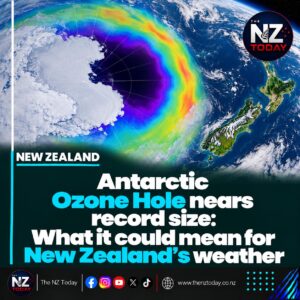
Scientists are closely watching the Antarctic ozone hole after it expanded to one of its largest September sizes ever recorded, with researchers warning that unusual atmospheric behaviour had signalled the possibility of a major event months in advance.
The ozone hole reached about 27.4 million square kilometres this month, placing it among the biggest observed for this stage of the year. While the size is significant, scientists say the total loss of ozone is not as severe as some of the largest events recorded in previous decades.
Researchers say the development was linked to unusual conditions high above Antarctica, where a stronger and colder polar vortex created an environment that allowed ozone depletion to accelerate.
The early warning signs appeared in May, when scientists detected changes in atmospheric circulation patterns that suggested the Antarctic polar vortex could become more intense during the spring season.
The polar vortex is a powerful ring of winds that forms around Antarctica during winter. When temperatures inside this system become extremely low, chemical reactions can activate ozone-depleting substances and accelerate the destruction of ozone molecules.
Despite this year’s large ozone hole, scientists say international action to protect the ozone layer is continuing to deliver results.
The Montreal Protocol, signed in 1987, has significantly reduced the use of chemicals responsible for ozone damage, with levels of ozone-depleting substances now about one-third lower than their peak.
However, scientists say natural atmospheric changes can temporarily influence recovery. Events such as unusual wind patterns, volcanic activity and wildfire-related particles in the atmosphere have contributed to larger ozone holes in recent years.
The 2020s have already seen several unusually large Antarctic ozone holes, including periods affected by smoke from Australian bushfires and volcanic emissions from the Hunga Tonga-Hunga Ha’apai eruption.
For New Zealand, the concern is not a direct “ozone hole” over the country, but the wider effect it can have on Southern Hemisphere weather patterns.
A prolonged Antarctic ozone hole can influence the Southern Annular Mode (SAM), a climate pattern that affects wind movements around Antarctica. Changes in this pattern can influence New Zealand’s rainfall, temperatures and wind conditions.
Scientists say a positive phase of SAM is often associated with calmer conditions and warmer, wetter weather patterns for parts of New Zealand, while other phases can contribute to stronger wind events.
Researchers expect the 2026 ozone hole to remain significant through October and potentially into November if current atmospheric conditions continue.
Long-term forecasts still suggest the ozone layer is on track for recovery later this century, but scientists say recent years highlight the complexity of the process and the importance of continued monitoring.
Source: Based on research originally published in The Conversation and scientific analysis of Antarctic ozone observations.