Auckland (The NZ Today)
Fake political claims, AI-generated images and misleading election posts are increasingly circulating across New Zealand social media in the final days of the campaign, prompting fresh warnings for voters to verify what they see before sharing it.
The issue has gained attention after RNZ highlighted several false claims spreading online, including fabricated stories that Chris Hipkins had died, Labour planned to make Dame Jacinda Ardern governor-general, and National intended to replace Labour Day with a new “National Day”.
None of those claims are true.
The examples underline a wider problem facing voters in 2026: political misinformation no longer always comes from obviously fake accounts or badly edited images. Some posts now imitate real news organisations, use AI-generated visuals and circulate through pages that appear local at first glance.
AAP FactCheck has separately identified false claims targeting Labour leader Chris Hipkins, including fabricated stories about his personal life and supposed legal action against TVNZ. Some of the material used AI-generated images and was distributed through overseas-run social media pages.
That makes one habit increasingly important for voters: verify the original source before believing or sharing political content.
If a post claims a party has announced a major new policy, check whether the same announcement appears on the party’s official website, verified social accounts, or established New Zealand news outlets.
If it does not, that should immediately raise questions.
Voters should also look closely at the page publishing the material.
Some social media pages use names designed to sound like legitimate newsrooms, while Facebook transparency information can reveal that a supposedly New Zealand-focused page is actually being managed from overseas.
RNZ has previously reported on foreign-run pages producing large volumes of AI-generated New Zealand political content designed primarily to attract clicks and engagement.
Another useful check is the promoter statement.
The Electoral Commission requires election advertising by parties, candidates and registered promoters to identify who has authorised it. Political material that appears to be an advertisement but has no promoter statement may warrant closer scrutiny.
AI has made the problem more complicated.
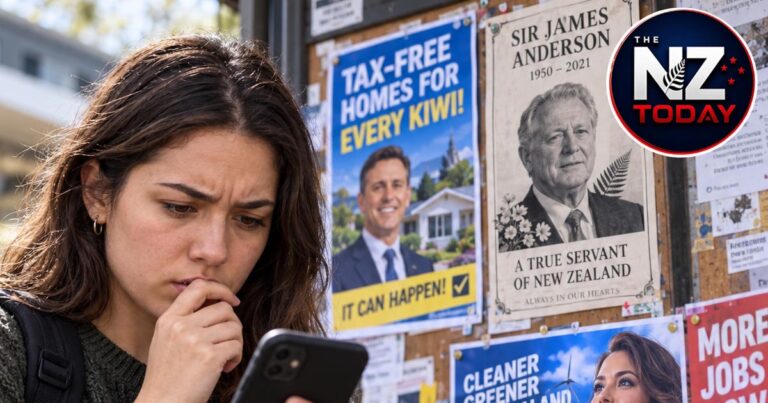
An image of a politician standing beside an apparently official campaign poster can now be generated within seconds, while video, audio and graphics can be manipulated to create statements that were never actually made.
Visual clues such as distorted text or unusual facial details can still help, but they are no longer enough on their own.
The more reliable question is: has this been independently confirmed?
If a post claims something significant about Christopher Luxon, Chris Hipkins, Winston Peters, Chlöe Swarbrick or any other candidate, a genuine major announcement would normally appear across multiple credible sources.
If it exists only on one viral Facebook page or TikTok account, caution is justified.
There is also an important difference between political spin and outright deception.
Misinformation can be inaccurate information shared without deliberate intent to mislead.
Disinformation involves false material being knowingly created or spread to deceive.
Another category, sometimes described as malinformation, involves genuine information being selectively presented or stripped of context in a way that creates a misleading impression.
Election campaigning itself can include exaggerated claims, selective statistics and aggressive attacks between parties. That does not automatically make something disinformation.
The key question is whether the information itself has been fabricated, altered or deliberately misrepresented.
Voters should also remember that social media feeds are not neutral.
Platforms tend to show users more of the content they already interact with, which can create the impression that one political view or claim is far more widespread than it really is.
Reading across several credible New Zealand outlets and checking official sources can help break that cycle.
The Electoral Commission also advises people not to amplify suspicious material unnecessarily. Sharing a false post to ridicule it can still increase its reach and push it into more users’ feeds.
With voting already underway, misinformation has the potential to influence perceptions in the final days before November 7.
Source: RNZ and public guidance on election advertising and online misinformation.