 Auckland (The NZ Today)
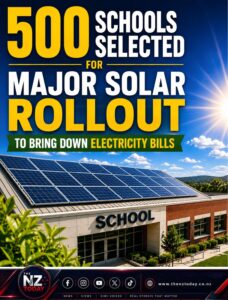
Five hundred schools across New Zealand have been selected for a $30 million Government solar programme aimed at cutting electricity costs, improving energy resilience and putting more renewable power on school rooftops.
Energy Minister Simeon Brown and Education Minister Erica Stanford announced the nationwide list at Te Papapa School in Auckland, which has become the first school to have solar panels installed as part of the programme’s pilot.
The Solar on Schools programme, funded through Budget 2026, will see solar systems installed at eligible schools over the next three years, subject to on-site assessments confirming each property is suitable.
Of the 500 schools selected, 340 are in the North Island, 157 in the South Island and three in the Chatham Islands.
Brown said the announcement marked the move from planning to actual delivery, with the programme intended to reduce schools’ dependence on electricity from the grid and lower ongoing energy costs.
The schools were selected because they are experiencing energy or fuel insecurity, facing higher energy costs, scheduled for gas or diesel boiler replacements, or identified as needing greater energy resilience.
Alongside the rooftop panels, up to 150 schools will also receive energy-management systems designed to help them better control and monitor their electricity use.
Selected schools will additionally receive battery storage where assessments show batteries are likely to provide the greatest financial savings and resilience benefits.
Stanford said generating electricity directly from school rooftops would reduce the amount schools need to buy from the grid, while also cutting emissions.
For larger schools, the financial impact could be significant. The Government estimates they could save an average of around $8,000 every year on electricity costs.
Those savings, Stanford said, could instead remain within school budgets and be directed towards teaching and learning.
The Government also sees an educational benefit in having renewable technology operating on school grounds, giving students a practical example of how solar generation and modern energy systems work.
Brown said the nationwide programme could also create opportunities for local and regional businesses involved in solar planning, design, installation and energy technology.
An Expression of Interest has now opened through the Government Electronic Tenders Service (GETS) seeking solar-system planners, designers and installers capable of helping deliver the programme around New Zealand.
The $30 million initiative is being jointly funded, with $20 million coming from the Energy Efficiency and Conservation Authority’s Community Renewable Energy Fund and $10 million from the Ministry of Education.
While all 500 schools have been identified as eligible for the programme, their participation will only be confirmed after individual on-site assessments establish whether solar installation is practical and suitable.
The Ministry of Education has also published the full list of eligible schools.
The Government says the programme is designed to make better use of buildings already available across the education network, while reducing electricity costs and strengthening schools’ ability to manage future energy pressures.