 Auckland (The NZ Today)
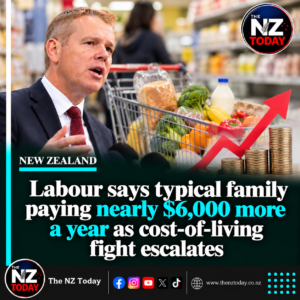
Labour has turned the cost-of-living debate back on National, releasing new campaign material claiming a typical family with two children is now paying almost $6,000 more a year than in 2023.
The eight-page document, titled “The Cost of Luxon,” targets household expenses including food, petrol, power, rates, healthcare and getting children to school.
Labour campaign chair Kieran McAnulty said the party’s calculations showed families were being squeezed across several everyday costs despite National’s promise to ease pressure on household budgets.
According to Labour’s breakdown, the extra annual cost for a typical family includes about $1,490 for petrol, $1,226 for food, $1,001 in rates, $404 for power and $1,558 for children’s public transport, along with higher GP costs and other fees.
That adds up to $5,857 a year, or more than $110 a week.
Labour says some households could be paying even more depending on their circumstances.
The attack follows National’s own criticism of Labour’s fiscal plan, with National arguing Labour has an $18.8 billion funding gap across its election commitments and saying that would eventually cost households more. Labour disputes that claim and says its policies are fully funded.
The latest exchange shows cost of living has become one of the central battlegrounds of the campaign, with both major parties now accusing the other of leaving households worse off.
Labour’s document also highlights more than 30 fees and levies it says have been introduced or increased since 2023, including vehicle registration, passport charges, electricity lines costs, ACC motor vehicle levies and some Department of Conservation fees.
On petrol, Labour’s calculation is based on an estimated extra $37.25 per fill-up compared with 2023, multiplied across 40 fills a year. National has argued international events, including the US-Iran conflict, have played a major role in pushing fuel prices higher.
Labour is using the comparison to promote its own cost-of-living package, which includes three free GP visits a year, cheaper public transport, a three-year fuel tax freeze and the return of locally made school lunches.
McAnulty also challenged National to spell out what further “reprioritisation” would mean for public services, saying voters deserved more detail on where future spending reductions would fall.
National, meanwhile, has argued its fiscal plan prioritises health, debt reduction and a return to surplus before any further tax cuts.
Meanwhile, with both parties sharpening their economic messages, the question of who can credibly lower household costs is becoming a major line of attack ahead of the election.
Source: Labour Party campaign material and additional reporting context from RNZ.