 Auckland (The NZ Today)
New Zealand political parties have received nearly half a million dollars this year through a legal donation system that keeps the identities of donors hidden from both the public and the parties receiving the money.
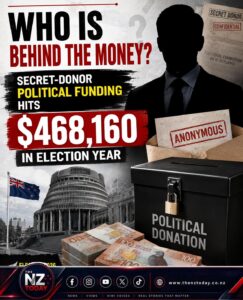
Electoral Commission records show $468,160 was paid out through “donations protected from disclosure” in the six months to June—already well above the $326,390 recorded during the entire 2023 election year.
National received the biggest share at $316,160, followed by the Opportunity Party with $70,000, New Zealand First with $57,000 and ACT with $25,000. No payments to Labour, the Greens or Te Pāti Māori are listed for the same period.
Under the scheme, an eligible New Zealand-based person or organisation sends the donation to the Electoral Commission, which combines it with other protected donations before transferring the money to the chosen party. The party is not told who provided it.
A donor can give up to $61,425 to each political party through this channel during an election cycle. Each party can receive a maximum of $409,500 in protected donations between two elections.
The rules are unusually strict: donors are legally prohibited from telling anyone that they have made—or intend to make—a protected donation. The system is designed to prevent political parties from knowing who gave the money and therefore feeling obligated to reward them.
However, critics argue that the lack of public disclosure makes it difficult for voters to independently confirm whether the promised separation between donors and political parties is working.
Ordinary party donations totalling more than $6,000 must be publicly declared with the donor’s identity. Anonymous donations are generally limited to $1,500, but the protected-disclosure scheme allows significantly larger amounts to be given without public identification.
The Independent Electoral Review recommended abolishing the system, alongside wider reforms aimed at increasing transparency around political funding. Despite that recommendation, protected donations remain legal and their use has risen sharply in the current election year.
With National alone receiving more than $316,000 through the scheme, the growing flow of identity-hidden money is likely to renew debate over a central question: should political donors have a right to privacy, or should voters know who is helping fund the parties seeking to govern them?
This story was first reported by RNZ.