 Auckland (The NZ Today)
A new RNZ-Reid Research poll has delivered a major shake-up in the election race, with National falling below 26 percent, the Greens making the biggest gain and the Opportunity Party once again sitting in a position that could prove crucial to forming the next government.
National has dropped 3.2 percentage points to 25.9 percent, its lowest result in the Reid Research series since the 2020 election. Labour remains ahead on 30.8 percent, although it too has slipped, down 1.4 points from the previous poll.
The strongest movement has come from the Green Party, which has climbed 4.6 points to 14.8 percent.
New Zealand First sits on 10.6 percent, down 1.3 points, while ACT has gained the same amount to reach 9 percent.
The Opportunity Party is on 5.5 percent, keeping it above the crucial 5 percent threshold for a second consecutive RNZ-Reid Research poll.
Te Pāti Māori has fallen to 2 percent, while other parties collectively account for 0.7 percent.
On the poll’s basic seat projection, National would receive 32 seats, NZ First 13 and ACT 11, leaving the current governing parties with 56 seats — five short of a majority.
Labour would have 37 seats, the Greens 18 and Te Pāti Māori two, giving those parties 57 seats.
That leaves Opportunity’s projected seven MPs in a potentially decisive position. Adding them to the current coalition would produce 63 seats, while Labour, the Greens, Te Pāti Māori and Opportunity would reach 64. Labour and the Greens together with Opportunity would also reach 62 seats.
Those calculations come with an important qualification: Opportunity is only half a percentage point above the threshold and would need either at least 5 percent of the party vote or an electorate victory to enter Parliament.
The projection also assumes there is no overhang caused by parties winning more electorate seats than their party-vote entitlement.
The poll contains another notable shift in the preferred prime minister numbers.
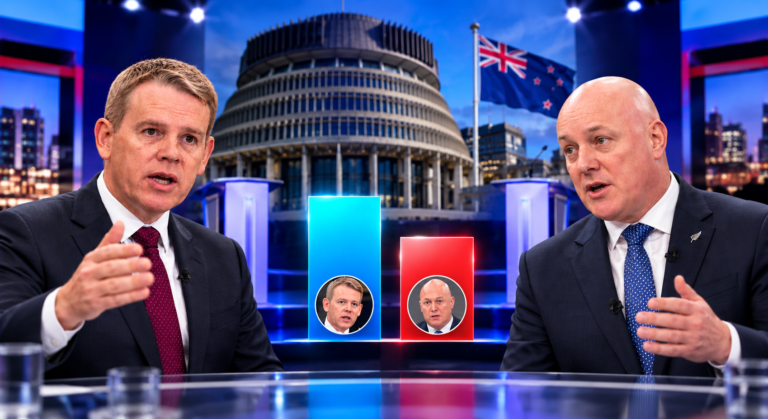
Chris Hipkins leads on 21.9 percent, up slightly from the previous poll, while Christopher Luxon has fallen to 17.1 percent.
Winston Peters is third on 11.2 percent, followed by Chlöe Swarbrick on 8.7 percent and David Seymour on 7.6 percent.
The results also show the traditional two-party share continuing to shrink. Labour and National together now account for 56.7 percent of party-vote support, compared with 61.3 percent in the previous Reid Research poll and 64.9 percent at the 2023 election.
That shift has increased the importance of smaller parties as coalition negotiations become a bigger part of the campaign conversation.
The poll was conducted online by Reid Research among 1000 eligible voters between September 24 and October 1. It has a reported maximum margin of error of ±3.1 percentage points at the 95 percent confidence level.
Party-vote results exclude respondents who said they were undecided, did not know or would not vote.
With about a month remaining until election day, the latest poll shows a fragmented political landscape — Labour leading National, the Greens strengthening considerably, and neither major bloc reaching a majority without additional support.
Source: RNZ-Reid Research poll